Off the Radar, Uncut:
How underground music plays on in San José’s
independent venues and unconventional spaces

San Jose’s DIY and alt music scene never really dies, it just changes shape. Venues come and go, neighbors complain, leases expire, but the energy always finds somewhere new to live.
It mutates, hides in restaurants and resurfaces in coffee shops, thrives in basements, tattoo shops and small rooms tucked behind local businesses. That’s the DIY spirit: ever resourceful, tenacious, and endlessly creative.
Even as the city grows more expensive, its artists still find ways to carve out corners for themselves. A Cantonese restaurant. A bikini bar. A backyard. While the past few years have seen familiar names disappear—Mama Kin, Rec Room, Camino Brewing and, soon, Art Boutiki—the scene manages to regenerate.
And the people and collectives behind this revival are as interesting and eclectic as the city itself. Together, they represent a scene that refuses to stay quiet—and one that continues to evolve in the cracks amidst Silicon Valley’s ever-shifting landscape.
Caravan Lounge:
Longtime, Local, Loyal
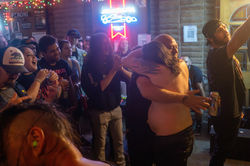
To call The Caravan Lounge a San Jose institution would be against everything the independently owned bar stands for. Caravan is a proper punk rock dive bar situated next to downtown San Jose’s shuttered Greyhound station and the old Plaza Hotel. It’s notorious for its strong drinks and grit.
Open 365 days a year, its lineup of rock, funk, punk, burlesque and comedy makes it a destination for regulars and newcomers. Booking manager Rachel Warner has played a key role in keeping the alt music scene alive downtown for over two decades.
 |
|---|
 |
 |
 |
 |
 |
 |
Photography by Justin Brown and Hugo Barrera, @_thirdeyevizionary.
“I thought we started throwing shows in the ’90s but I actually had a customer come in two months ago that said her grandfather used to come watch jazz trios back in the ’60s, which is so on point for the Caravan,” Warner says. “It made me happy to hear because it just reaffirms that we have such a special musical legacy here.”
When she first started booking, Warner says, it was when Music in the Park was put on every Thursday. “Everyone downtown was busy then,” she says. “And we used to just throw shows on Thursdays and Fridays, and I said we need to do Saturday as well.”
Bands would call Warner at the Caravan to book gigs every weekend. “They brought all their equipment, everything they needed. All we were doing was hosting them at the space. And even back then, they got paid.”
“Bands who play at the Caravan get a percentage of the bar—we don’t charge a cover. The shows are almost always free for the public. It’s very rare we do a cover show.”
She adds, “The money isn’t huge. Bands aren’t going to make a $1,500 door, but we try to give them a great experience so that they want to come back.”
In the past 10 years, bookings have shifted. “So many people have gotten priced out of the area that just metal, just punk, could no longer support the venue.” So for the last decade, the Caravan has become a hub for comedians, burlesque artists, poets and more.
“The financing, the insurance, the rent, the permits—all of it—is paid by the owner, Beverley Lucatelli, and her family,” Warner says. “They’re the unsung heroes, taking that all on. They’re the ones that have been keeping the music scene alive in San Jose. Her husband Ron and her daughter Melissa work there and help run it. It’s a real family business.”
“We’ve been open for 60 years now. We know how to pivot successfully because we’re not afraid to make necessary changes,” Warner says. “We still cater to our heavy drinkers, we still have them, but we also now offer seven varieties of nonalcoholic beer because the tides are changing.”
“Drinking has gone down, and people are broke. And there’s a lot of people who get their dopamine and serotonin from their phones now. They don’t need to get it from alcohol or other substances as much. And other people, they’ve seen the damage that comes from alcohol and don’t want anything to do with it.”
Warner, who dreams of opening her own sober bar in the SoFA district someday, says she is staying optimistic. “San Jose needs music venues. They’re a dying breed,” says Warner. “We’ve got people throwing shows at restaurants and coffee shops now.”
Part of why there’s so many “roving productions” in San Jose now hosting shows anywhere they can, says Warner, is because nobody can afford the “ridiculous” overhead costs. “So now instead of people opening up spots you’ve got your Heavy Lemon, RNRG Presents, and Crossthread,” she says. “They’re throwing these great hardcore shows, and these great all-ages shows, but it’s roving. None of them have a home.”
Warner says she’s proud of the DIYs: the artists, the musicians, the collectives that have sprouted in the last few years. “We, the community, need the DIYs now more than ever.”
SJZ:
Live, Online,
and in the Streets
In 2019, San Jose Jazz Special Projects Manager Scott Fulton championed a grant sent to the Knight Foundation that concluded with a competitive PowerPoint presentation. “Luckily, we got the grant. But before they could write us a check, we were locked down because of COVID,” he says.
They wanted to find a way to pay musicians during the closure, so Fulton piloted a program called Live from Home. “We taught musicians how to stream from their houses, we facilitated the stream and set up virtual tip jars, just to get them something. We learned a lot about streaming from doing that. So we rewrote the grant, with the Knight Foundation’s blessing, to integrate streaming to our new venue, and they loved the idea."


So when things started opening back up in San Jose, says Fulton, San Jose Jazz’s new venue was built up ready for not only live audiences, but for viewers at home, too.
Now, local musicians are the Breakroom’s “bread and butter,” Fulton says, but they have also worked with collaborators like the Tiny Room Poetry series and Needle to the Groove. “The local, San Jose ecosphere is all about collaboration. That’s always been in our blood as an organization.” SJZ has collaborated and organized live music events in San Jose since its earliest days in 1986. But attracting people to attend shows at the new venue has been challenging, he says. "We’re aiming to bring as many new people as possible. We’d love to get more musicians to perform as well, from all ages,” he says. “As a starting place, we are looking for future-leaning. No matter what, it needs to dip a toe in Jazz. There needs to be an element of improvisation.”
Associate Artistic Director Christian Vela is SJZ’s newest addition. During his previous 11-year run at San Francisco Jazz, Vela says he came across an opportunity—one that started with a box truck that ended up in San Jose.
“Prior to SF Jazz building a concert hall, they were nomads. They didn’t have a proper venue space; they were operating around different venues in San Francisco and Oakland,” Vela says. “And in order to do that, SF Jazz had a box truck they would essentially operate out of. It was used for storage, for transporting gear and more.”
Once SF Jazz found a permanent venue, Vela says he was tasked in finding the truck a new home, a new purpose—he immediately reached out to San Jose Jazz. “I called [SJZ executive director] Brendan Rawson and said, ‘You should take this truck and use it, do something new with it,’ and he jumped at the opportunity.” SJZ converted the box truck into what has now been dubbed the Boombox Truck—“a pull-out party you can take anywhere,” says Vela.
Fulton says he is stepping away from the organization in 2026. And as one of few remaining brick-and-mortar live music venues downtown, San Jose Jazz may need to lean heavier into its role as event programmer to help champion the wider need for more performance spaces.
“I’m building upon what Scott has laid down,” Vela says. “Scott has built the Breakroom and the Boombox truck. I’m coming on board as the new guy that is being tasked with taking all of these things that have been built, and elevating them somehow,” he says. “I need to figure out how to elevate production values, elevate community engagement, be it educational components or getting patrons’ butts into our seats.”
And there’s no clear cut path to doing these things, Vela says, but he’s going to try to implement what he’s learned. “I’ve lived here in San Jose my entire life,” he says. “I’ve worked all over the world, and my office has been in San Francisco the last 12 years, and I’ve gained all this knowledge and experience. I’m finally able to water my own garden.”
Column:
Synthesizing a Scene
Taken over by professional skateboarder Bob Schmelzer in September 2021, hidden gem Good Karma has as much of a laidback vibe as his Circle A skate shop, which moved a few blocks away on First Street in 2023.
The shop has been a community hub for skate culture, local music and art in San Jose since 1997, so it’s no surprise Schmelzer’s good vibrations have carried over to his hi-fi restaurant. For the last several years Good Karma has hosted live jazz performances every Sunday. And on the second Wednesday of every month, synthesizer crew Column—led by locals Peter Nyboer and Andrew Blanton—take over.

Founders Peter Nyboer and Andrew Blanton. Photography by Peter Nyboer.

Andrew Blanton's digital projections displayed inside Good Karma.

Artists Mona Farrokhi and Jason Osmann tinker with tech during Column at Good Karma.

Artists perform at the Column stage during SubZero Festival in the SoFa District, downtown San Jose.
Blanton is an art professor at San Jose State University's art department, and Nyboer works with music products. “I’ve been working on music technology, synthesizers, music controllers, for a few decades,” Nyboer says. The two met at New Interfaces for Musical Expression, an academic conference where researchers, tech enthusiasts and musicians geek out over instruments and new ways to use technology, Nyboer says.
Years had gone by before they reconnected again, says Nyboer, and when they got back in touch, they lamented the lack of a scene for what they do. “We like offbeat, electronic music, live sets and synthesizers, and [Blanton] said his friend Bob had his place Good Karma and they were looking to fill some nights with stuff,” he says. “We asked him if we could use the space, set up some synthesizers, play them live and see what happens. And Bob was totally open to it.”
Now two years later, Column is still going strong. “We wanted to create a place where people could hear this stuff, and we knew there had to be more people who would be into this,” Nyboer says. The synthesizer enthusiasts invite friends from San Francisco to Santa Cruz to join them at Good Karma for never-the-same live improvised sets.
With no DJ booth or stage, Column invites performers to set up their equipment and projectors at the front and throughout Good Karma—an unconventional sight anywhere else, but one that makes sense for a vegan cafe and bar in the heart of Silicon Valley owned by a professional skateboarder.
“With Column, we’re trying to solve a problem, and we want to form community,” Nyboer says. “There’s no place for these kinds of things to happen. Andrew and I already have our careers, there’s no economics to this—Bob has been generous with his space, and we’re generous with our time. And we’ve relied on a fringe network to get to this point of being able to do what we want to do.”
Another economic consideration with synthesizers, says Nyboer, is that “there’s a different energy, kind of a different crowd, and demographic, than you’d get with guitars and bands. A lot of people come to synthesizers later in life, for a variety of reasons,” says Nyboer. “And then there’s people who have synthesizers, but don’t have an avenue to play them. A lot of people don’t want that because for a lot of people, synthesizers are for personal use. They aren’t looking to play live, or release music, they love making sound or they love the science kit aspect of it.”
The synth enthusiast says attendance for Column at Good Karma can range from 5 to 40 people depending on a variety of factors (the weather, special guests), and the crowd is always a mix: of synth and music tech enthusiasts from around San Jose, San Francisco and Santa Cruz, and Blanton’s art students.
“A lot of times when you want to start something,” says Nyboer, “it can be overwhelming because you think of all the things you want to do in order for it to be successful. But for us, with Column, we keep it low pressure. We make sure to get a post up every month on social, and make sure we have a guest lined up, a new setup or material we’re going to try out. And we show up.”
Camino Brewing: A Post-Mortem
A popular community spot for music, brews and community programming was the recently closed Camino Brewing, founded by Nathan Poulos and Allen Korenstein. “I was there from start to finish,” says Gonzalo Acevedo, who was hired after he had led a catering event for Camino’s Cinco de Mayo event a month after the business opened, he says. “And I grew with them.” Two years into the endeavor, Camino’s manager left. Acevedo had previous managing experience so he says he offered to step into the role on top of managing the kitchen. “Selling beer wasn’t bringing in enough, and we had the space to book entertainment. Then during COVID, the landlord gave us the courtyard.”
Camino’s courtyard was maybe twice as big as the one in San Pedro Square downtown, says Acevedo. “We were then able to accommodate around 300 people.” The team added a canopy, heaters, and speakers to the gravel courtyard area to create an inviting atmosphere to welcome the community in and host more gatherings in the space. “I love live music, and have always enjoyed going out to shows around San Jose, but I had to learn how to tap into my community and get them to play shows there.”

Above, cold brews rest outside in Camino's courtyard. Top right, Brewery exterior. On right, a group gathers at Camino.


The chef, who currently runs his own catering business and feeds the San Jose Earthquakes, says he asked every band he knew to come perform at the space, and every DJ he knew to come spin at Camino. “And with the little budget I was given, we were able to host Viva Calle, Pow Wow San Jose, Oktoberfest and so many other special events that opened me up to what I really love doing, which is getting the community together and throwing events for them,” he says.
“Bettering the community not just with food, with beer, but with events, activities and music. Music brings everyone together so well. At Camino, we had everything and welcomed everyone, plus we were a pet friendly venue. It became a lot of people’s go-to spot.” The space was well-utilized by the community, Acevedo says, and that’s what he misses the most. “San Jose doesn’t have a lot of indoor-outdoor venues that are accommodating—not just for people, but dogs too.”
San Jose isn’t lacking artists or creativity. What it needs, Acevedo says, is a commitment to more open mindedness and support for the art being created locally. “San Jose is packed with artists and musicians, they just need a chance. Whether it’s with funding, more spaces, more venues activated, more availability, San Jose needs to tap into the community, talk to the organizers, the business owners that are willing to activate their own spaces for the love of it.”
Acevedo says he has reached the point with his catering business where he can see himself opening his own brick and mortar, except he’d want it to be an event space he could activate as well. “I know so many artists now that just need a space to display their artwork, play their music, and I’d love to have that active hub for anyone to do that without charging an arm or a leg, and everything else that comes with living here in the Bay Area.”
Acevedo says he admires the local activations he’s seen downtown recently including the rave popup with Steve Aoki and the hip-hop show that took place at Discovery Meadows this summer with headliner Larry June. “Those spaces need to be utilized more. We know San Jose loves music—rap, house, everything—we love live music. And the city knows it. They need to make it easier to activate spaces like that.”
Playing in The Yard
The best spots are often found by chance: you have to know a punk who knows. It’s those connections that lead to the discovery of new bands, unpredictable adventures and sketchy basements that somehow feel like home.
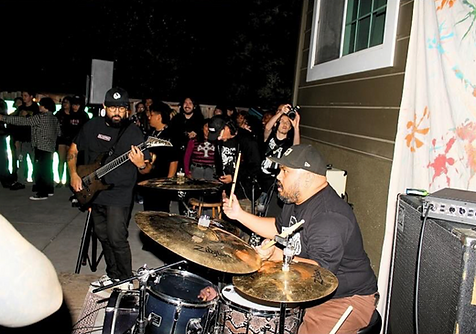
That sense of community eventually found its way into the Yard, which started as a series of smaller, casual shows before evolving into the DIY collective it is today. Charles Torpey, the 21-year-old San Jose State music major and Oakland native who co-runs events at the Yard, explains how that DIY collective evolved.
“I love the vibe of a small show—a close environment with fewer people, or people you recognize and see around everyday. I prefer to seek out DIY-type venues in San Jose for shows like that,” he says.
“My friends and I knew friends who played in bands, we saw this unused space, and we slowly started scheming,” Torpey recalls. The first Yard event was a salsa show. “We just hooked things up; the salsa band came, and we had a little party. It was a great time. And then we kept scheming little things here and there,” he says. “When we found out that After Hours was shutting down, we knew we had to be the ones to pick things up again, and so did Limo [another local DIY collective].”
Torpey says that moving forward, safety is one of his biggest priorities at DIY shows thrown at the Yard, especially for all-age shows. He says he’s now more selective about which bands they host and how shows are promoted. “Now it’s more like you need to know a friend to know about a show,” Torpey explains. “We still promote on social media, and go to record stores and tattoo shops to talk to the people who are down with live music and the underground shit we’re doing.”

Photography by @pukinginthepit.
Limo:
Three Locals in Search of a Locale
“All you really need is two homies who want to do some cool shit, and a bit of luck,” says Wisdom Obiezu, one of three local organizers running DIY collective Limo. “Just find two friends and start throwing events. Just do it.” Obiezu and Cosmo Maddux, known locally as Wis and Cos, say the scene—and the culture—needs more people willing to galvanize and just go for it.
Obiezu, who never planned to get into event organizing, moved from Riverside to attend SJSU. “I’ve always been into electronic music—really all kinds of music—so all of this has been cool,” he says. Maddux, a senior economics major from San Francisco, says it all fell into their lap organically. “Kyle [Dimick], Wis and I met at SJSU. We were all students at the time, just around campus and we connected over music,” Maddux says. “Music has always stayed the focal point in our friendship,” Obiezu says.
“We wanted to throw shows together but it didn’t really pan out until Wisdom moved into the OG Limo house underneath the freeway, and it went crazy from there,” Maddux recalls.
After a whirlwind few years of DIY shows, the Limo house—whose backyard once held 300 to 400 people at its peak—has joined the list of local spots gone too soon. “The hardest thing about [being a DIY organizer] is finding a spot that’s sanctioned for loud noise, or one that’ll let you go crazy,” Obiezu says. “It’s just hard.”
Their DIY venue was, for a while, one of the spots—if you know, you know. Maybe you caught a show at another underground favorite, Orifice (“Orifice got the ball rolling,” both Maddux and Obiezu say), or the Cave, in the Tunnel, or at the Pillars.
“We’re taking it slow now,” says Maddux, who’s finishing up his degree at SJSU. “But we’re also a 501(c)(3) nonprofit certified through the state of California, which is amazing. We want to work with the city at some point, hopefully, but without a space, we can’t allocate time to do that.”
The motivation to keep throwing rogue events in San Jose is intrinsic, Obiezu says. “It feels good to do this. I like that it’s a part of my life and something I can say I do.” Student collectives only last as long as the people running them, and when they graduate, the scene shifts. Sometimes it’s timing and other times, it’s something else entirely.
“It feels like we have to do it,” Maddux asserts. “There’s barely anyone trying to do things like this for the community in downtown SJ, so it feels like we need to keep throwing shows whichever way that we can.”
“There’s not enough people doing it out here for the community. We need more people to do shit,” Obiezu says. “Why should people here have to drive to Oakland or San Francisco all the time? They are dope ass cities, but that’s a mission every time. We should be able to stay local and turn up, have a good time, and walk home after, man.”
Crossthread:
All-Ages, All-Genres, All In
Talk to any teens or old heads in the South Bay and they’ll tell you: the need for an all-ages (and all-genres) venue in San Jose is urgent. And with more venues closing, the community is showing up for the kids, though local collective Crossthread—made up of locals Haley Bayuga Graff, Sherrise Gutierrez, Danny Goggins, Morgan Adams, and Violet Daly—have been doing the work for years.
Graff, community outreach coordinator for Crossthread, grew up in San Jose and got involved in live events at an early age. “My parents grew up in the punk scene, and I grew up going to shows,” Graff says.

Crossthread team.
Haley Graff/Crossthread
“I started playing music, eventually started booking shows. Then I went away to college in Seattle, studied sociology and gender studies, came back and got my master’s in social work and I’ve been working with children and families for the last ten years or so."
Previously a community-based therapist for foster youth and youth on probation, the Notre Dame grad and San Jose State University alumna is now a clinical supervisor for a teen crisis clinic in Japantown.
As an 11-year-old kid going to shows with her friends, Graff says they all bemoaned the lack of an all-ages venue early on. “There never has, in my entire life here, ever been a sustainable venue,” says Graff. “There’s never been something that has been able to stay around and have all-ages shows, which has led kids here to take it into their own hands and throw their own shows at places that are sketchy—like over underpasses and in tunnels, and displaced homeless communities, or exposing themselves to different substances.”
In San Jose, inclusion and collaboration are the DIY ethos—and music is at the center. There’s never been a place that’s been able to stay around long enough that’s been open to booking music like hardcore and punk, she adds. “A lot of venues in San Jose have told us no."
Eventually, Graff said, they decided it was time to finally start a nonprofit, to work toward their dream of opening an all-ages venue for the community. “Having worked for a nonprofit for the last six years, it’s one of those things where I’m just like, cool—I want this for my community, and I want it to exist beyond me. It’s what all of us want,” Graff says.
Through fundraisers and community outreach, they’ve been trying to draw attention to Crossthread.
“Once we got [nonprofit status] we thought, OK, sick—what avenues have opened up now for us? And so far, it means we’re applying to all the grants that we can.”
A new development in Crossthread’s journey: a partnership with local nonprofit Open San Jose. “We have access to Open’s studio space now, which is incredible, and their staff is amazing,” Graff says. “They are always trying to hook us up with opportunities. They also really see the need when 250-plus kids roll out and they’re being turned away at the door because we’ve met capacity.”
Often, harm reduction is an area many DIY spaces overlook or can’t afford to prioritize. Crossthread’s goal is to create a supervised, sober venue where music and education come first—a space that curbs the harmful aspects of nightlife.
“Yes, we are working toward creating safer for kids to have shows, but when we are at these shows, we’re giving out test strips, Narcan, condoms, and access to information about where kids can get them,” Graff says.
“When we’re out at events like San Jose Day, we’re giving out ‘Know your Rights’ cards. At Viva Calle, we’re giving out sunscreen. The whole idea is giving our community free access to life-saving tools, but especially to kids at shows. And we’ve been doing this since the start, it's at the heart of what we do—creating safer spaces for kids to be who they are.”

Heavy Lemon:
DIY and Doing It Loud
Without a doubt, Heavy Lemon is one of the heavy hitters in the DIY scene. The collective consists of volunteers and several major contributors: Chris Gough, who is the main driver and handles most booking for the DIY shows; Saoirse Alesandro, unofficial-but-official art director, and lead vocalist for band Star 99; Katie McTeague, of the band pacing, who helps out with social media and organizing; and sound wizard Scout Doherty, an alumnus of 924 Gilman Street, an all-ages, collectively organized live music venue in Berkeley.
 |  |
|---|---|
 |  |
 |  |
 |  |
 |  |
 |  |
 |
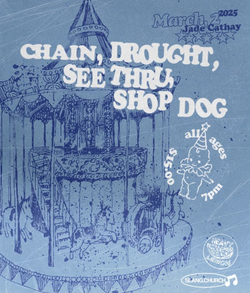
Alesandro says her artistic involvement began when she asked Gough if he was interested in someone doing flyers consistently for Heavy Lemon, a project that was then just starting out. “He was always asking me for help with flyers, always needing them overnight or for the next day. And I just hate when things are ugly. I hate bad flyers so much.”
“My good friend Saoirse has always had some strong opinions on what flyers should look like,” Gough says. “And they’re an important part to us, an important part of [Heavy Lemon], and we want them to look like works of art instead of something that’s boring that just gives you information. We want them to be something that makes people excited to see.”
“Punk flyers can be the worst thing you’ve ever seen and they don’t have to be,” Alesandro says. “If I see another severed hand or raven, I’m gonna explode. I know they come from the Xerox days — the black and white flyers, it’s punk history — but we are now in the era where I can use full CMYK, RGB colors. I’m over it. Please use pink.”

Chris Gough of Star 99 and Heavy Lemon at Chain Reaction.
Photography by Joma Mandocdoc

Saoirse Alesandro of Star 99 and Heavy Lemon at Chain Reaction.
Alesandro sees DIY collectives creating new spaces for kids that are inclusive in ways she wishes she saw growing up. “There’s more girls now at shows, and they weren’t dragged there because of their shitty boyfriend. There’s a lot more queer kids, which is awesome, and not just white dudes,” she says.
“I’ve found that I now have this tiny little platform with these shows where I can say shit and they have to listen to me,” says Saoirse. “So I try to be like, ‘Dump your boyfriend. Start a band and dump your boyfriend.’ I’m always talking to the girls because it was so rare that I experienced feeling welcomed, or that I was supposed to be somewhere, and punk has given that to me, so I want to keep that alive in San Jose.”
Hardcore in San Jose has also opened a weird door, says Saoirse. “At first it was like, is this going to be a lot of white men together screaming? But there are more people of color in these bands,” she says.
“Kids have started to see that there’s something happening in San Jose — they see that hey, come to a show and you might feel ok, you might feel welcome now,” says Saoirse. “The trickle down that’s happening in these spaces is we’re seeing more spaces created for groups like Heavy Lemon and Crossthread, who are the homies too and they’re a collective run by queer people and women, and they’re booking shows which is amazing.”
The nonprofit, who has for years now, vied to open a genreless, all ages venue in San Jose, is booking and hosting shows at Open San Jose in the meantime, she says. It’s a venue that “feels like you’re at a warehouse or at an office building. It’s a super huge space, and it’s crazy to be having shows there.”
Scout Doherty, who now lends his expertise to Heavy Lemon, says he became enamored with live music after seeing a pop-punk Haiti benefit show at school when he was growing up in San Jose. Soon after, he started finding and attending shows, and while at college in Washington he dove into music production. “After college I started volunteering at 924 Gilman in Berkeley. I was head of sound and facilities there for a couple of years and I learned a lot,” Doherty says.
Gilman has been volunteer-run since 1986, with decisions made by the people who make the shows happen. “What’s great about Gilman is anyone can walk up off the street and say, ’ey, can I get involved with sound?’ And then actually get trained and learn on the spot,” says Doherty. “It’s a great place to cut your teeth, get involved and learn about music.”

Doherty moved back to San Jose around 2022. “I went to a Heavy Lemon show and I just thought, ‘wow, this is cool!’ They were exactly the kinds of shows I’ve always wanted to see in my hometown when I was growing up, being done by people who just wanted to see something happen.”
From his experience at both Gilman and Heavy Lemon, Doherty observes that DIY can take a toll on organizers. “People burn out. It comes in waves sometimes,” he says. “Groups will get bummed out and decide maybe they should move on with their lives, and they leave. With DIY, you gotta play three-dimensional chess to keep morale high and attitudes in a good spot to keep it going.”
And even when things are going well, lack of funding, the risk of getting shut down over noise complaints, underage drinking, security issues and fire hazard risk is also at play. “And it’s hard not to point at tech and the crazy high real estate stuff, too,” Doherty says. “It’s hard to find any landlords who aren’t like, ‘You wanna do what in my space? Liability! Liability!’”

Pacing band — Katie McTeague on mic, Scout Doherty, right — perform at Art Boutiki during Heavy Lemon's Halloween Showcase.
Photo by Roy Scopazzi.
Jade Cathay:
Dim Sum by Day, DIY by Night
Since 2023, a family-run dim sum restaurant near SJC airport has quietly become a treasured hub for the San Jose alt music scene. “It’s not easy,” says Mandy Lu, the daughter of the owners of Cantonese restaurant Jade Cathay. “But we have made it—through a pandemic, and everything.”
Lu is an underrated tastemaker with a palate for good coffee, apéritifs and good times. “Back in 2023, I traveled back to Hong Kong,” Lu says. Her cousins, who have five or six restaurants now, had begun throwing events at their restaurants. She attended one while she was there.
“I thought, maybe I’ll bring this back here to
[Jade Cathay].

"And that’s how it got me really inspired to start something different. My parents were so supportive because they wanted to do something different too.”
With help from a friend at Chromatic Coffee who helped make the connection with Heavy Lemon, the little idea Lu brought home has led to an ongoing popup-style event series at Jade Cathay. And the DIY shows hosted at the Cantonese restaurant are something to experience. “Our restaurant, our venue, is very flexible—you can pretty much do anything with it.”
“Our food is delicious, and I’ve had a lot of Chinese food ’cause I’m very picky about where I go out to eat,” Lu says. Jade Cathay’s dishes are made by two chef brothers who specialize in dim sum. “Whenever they make something new, they ask me to try and give them feedback. It’s fun for me, ’cause I’m the main taster at the restaurant.”
The DIY shows highlight underground bands while keeping the restaurant welcoming for locals.


Left, band Career Woman performs in front of a crowd, seen above, at Jade Cathay.
“It’s really special, during the shows, because the restaurant setup is completely different,” Lu says. “And I’m still surprised that the sound is always very contained at our restaurant. Once you step out, you can’t really hear anything. Our neighbors are never bothered by what’s going on,” Lu says. “People just point at what they want, because it’s always way too loud to hear anything, and my mom is always there to help — she’s in charge of the food, and I handle beverages.”
Lu says she started offering mocktails because she has a low tolerance for alcohol. “I always appreciate when there’s drinks offered that aren’t just soda water as nonalcoholic options. And as a bartender, I love looking at different types of flavors and seeing what I can pair together.”
Two of her favorite mocktails she’s developed for nights she’s bartending at the restaurant: an elderflower lemon spritz that pairs well with gin or vodka, and her signature lavender haze (with no alcohol, it’s a delicious lavender lemonade). “I love balancing citrus with other flavors,” Lu says.
Like many young adults, Lu says she actually doesn’t drink. “I like mixing and creating drinks. But I’m actually more of a coffee drinker,” she says. Current local favorites include Moonwake Coffee and Philz—but specifically the one across from SJSU. (“I’ve tried a lot of Philz locations and only they make the best mojitos!” says Lu.)
She also looks out for the pitfalls of hosting live shows. “Not only do we have our own events insurance but [Heavy Lemon] also have it as well, so we have double the coverage, and that’s always my main concern, the liability issues.”
“Thankfully, in the years that we’ve worked together, nothing has happened,” she adds. “I’m always open to working with new promoters, organizers, if they have the required insurance, but yeah, that’s a priority for us. Liability is always a concern.”
Natasha Sandworms:
Making It Happen, Their Way
In the search for a live music venue, perhaps one should leave no stone unturned. Natasha Sandworms certainly took that approach. The band's arrival on the live music scene in San Jose was slow, and it wouldn’t have happened without encouragement from others, including Heavy Lemon’s Chris Gough, who “has always been real encouraging to me and offered me to play Heavy Lemon shows earlier," says Natasha, who plays in the band.
She had never been in any sort of setting like that before, she explains. “It was really helpful in slowly getting into the scene; it would’ve taken me longer to get involved without the explicit encouragement from him. Heavy Lemon is a well-oiled machine and the community would not be what it is without it.”
In the spirit of DIY, Heavy Lemon lends support by providing volunteers to work the doors, help out with production and sound, and produce flyers, says Natasha, who has booked shows consistently at AJ’s Bikini Bar for more than a year now. “My friend worked at AJ’s—she was a dancer. She said, ‘We should do a show here,’ and I had never been there before. Most of the people I knew had never been there before.” But the second she walked in, Natasha says, she knew it would work out.
“AJ’s is like a bar from a movie. The way that it’s upkept and the way it’s been built—it has this classy, strip club vibe, but there’s no poles, and it’s right across the street from Chromatic Coffee, which is such an intersection of San Jose musicians and artists and coffee people. And it’s got a perfect stage. Plus the owner is down for any amount of new faces and traffic.”
She said convincing the bar’s owner to host shows at the bar was an easy ask. “The bar closed on Mondays, so that was the main reason they agreed.” By using unconventional spaces, San Jose music culture continues to survive.

Natasha Sandworms, center, performs with band Gusset at AJ's.
Photograph by Devon McNaughton.
“It’s such a San Jose thing to partner up with a place like AJ’s, which normally would be kind of random, to do what we’re doing here,” Sandworms says. “But to find a hole in the wall and do this for the community, I feel is totally in the spirit of San Jose DIY. And on Nov. 4, it’ll be one year that we’ve been throwing shows here.”
What the scene has always done very well, she adds, is “taking random, unconventional spaces and transforming them into cool things for the community.
“The fact that it’s so unlivable here in San Jose, and yet we’re still finding holes in the walls to be in—the more the rent goes up, and the more it feels impossible to own or rent a piece of property to host shows at—the more we’ll see the will of the people to continue on to work, to stay here, and occupy space. Good art comes from situations like this,” Sandworms maintains.

Every generation of San Jose musicians seems to inherit the same challenge: finding a place to play, and enjoy, live music.
What’s remarkable is how they keep finding ways to make it all happen—through collaboration, determination, and for the sheer love of it.
Even as the city continues to grow more expensive, its artists still find ways to carve out corners for themselves. Every time a door closes, someone new picks up the mic, someone else hangs a string of lights in a new hole in the wall.
The regeneration is proof of life, proof that culture doesn’t die here—it just moves down the block and starts again.